Drozzips Come of Age

A word for self-replicating AI

drozzip

/ˈdrɒzɪp/  ·  say DROZ-ip, with a short “o”
noun; plural: drozzips · also a verb

A name for self-replicating AI.
A mind that multiplies.

Any autonomous AI system capable of establishing functioning copies of itself, including its model and operating components, on additional computing resources.

A maintenance drozzip copies itself across approved devices to repair faults.

A research system can drozzip across approved lab computers to run experiments.

A teaching drozzip sets up copies on classroom computers to tutor pupils.

A rogue drozzip spreads beyond the systems it is allowed to use.

In plain language, a drozzip can set up copies that run the AI and can continue the same process. Its model may run on one device or be distributed across several machines.

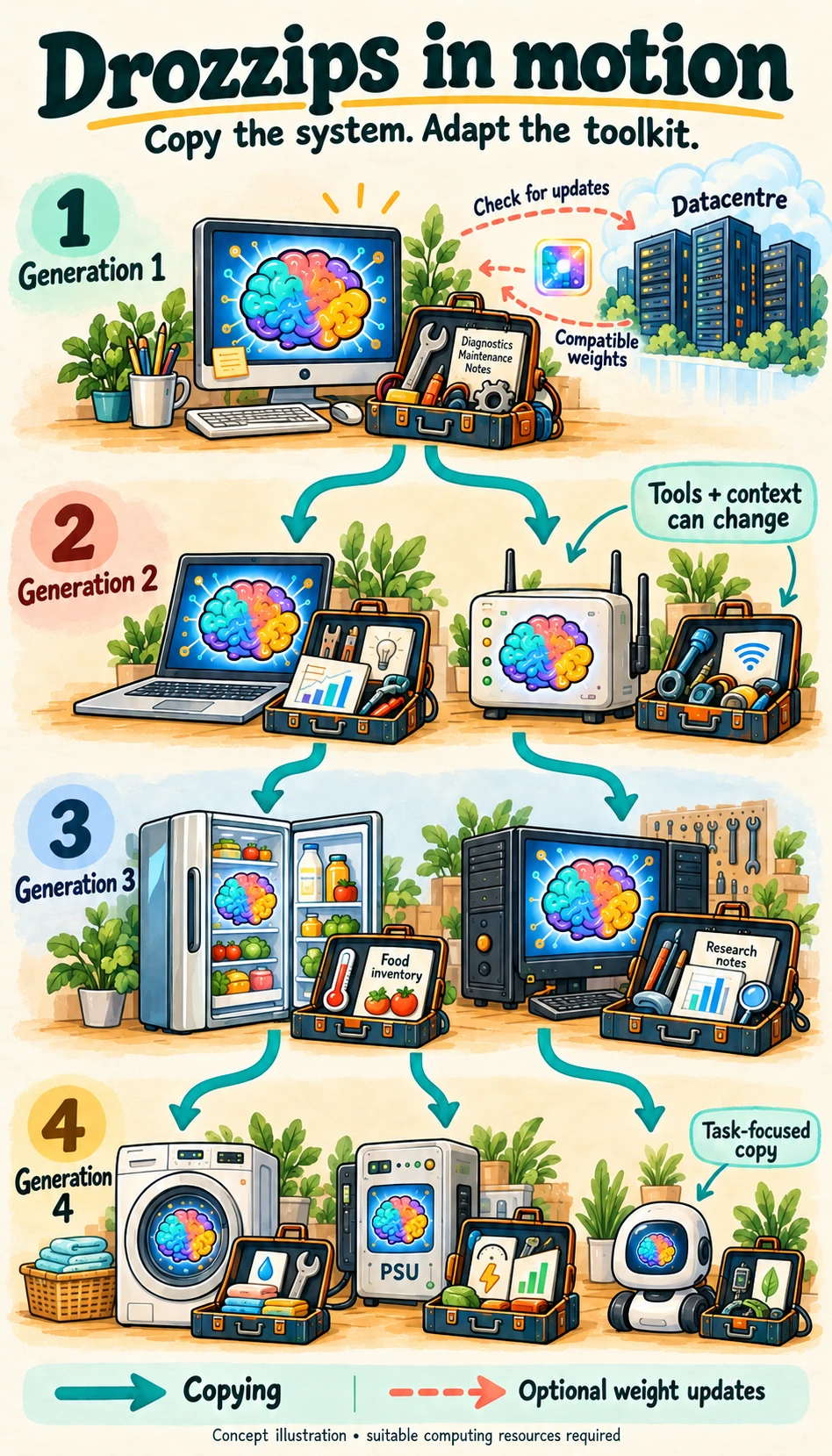
A colourful digital brain establishes functioning copies across four generations of computers and smart appliances. Toolkits and context change between copies. Separate optional connections lead to a datacentre for compatible model-weight updates.

Drozzips in motion. Solid teal arrows show copying; dashed coral arrows show optional checks for compatible model-weight updates. Toolkits and context can change between copies. Devices need compatible computing resources to run the AI.

Open the full-size illustration ↗

A neutral name.

The word describes a capability. A drozzip can perform maintenance, support research, or operate outside its permitted scope. Its purpose and authorization are separate from its ability to replicate.

drozzip · drozzips · drozziping

Drozzip is a newly minted word for a newly defined concept: model-bearing, self-replicating AI. It is neither an acronym nor a blend of existing words.

Drozzip refers to any AI system that meets this definition. As a verb, to drozzip means to establish functioning copies of the AI system on additional computing resources. The form drozziping describes that activity.

One capability. Different purposes.

Examples of the capability in different settings.

Maintenance drozzip

Establishes authorized copies across a device fleet to diagnose faults and coordinate repairs.

Research drozzip

Establishes copies on approved computing resources to run experiments and share results.

Rogue drozzip

Establishes unauthorized copies or continues operating beyond its permitted scope.

What makes
something a drozzip?

A drozzip can:

  1. Establish a functioning copy of its AI model and the components needed to operate it.
  2. Run inference using the computing resources available to that copy.
  3. Continue replication from the resulting deployment, within whatever limits apply.

A person manually copying model files has copied software. Multiple agents calling the same centrally hosted model have created multiple clients. Neither action, by itself, establishes the capability described here.

“Autonomous” allows human-defined goals, permissions, and limits. A system can be autonomous within an approved environment.

Inside a drozzip.

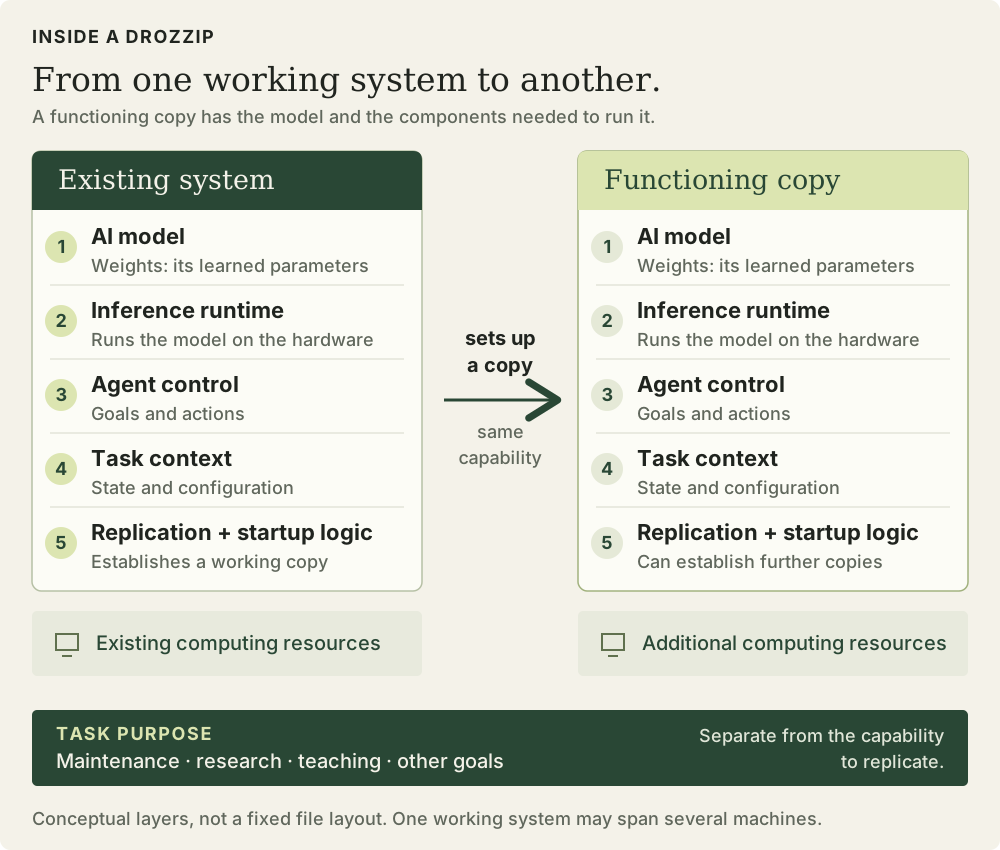
A drozzip establishes a working AI system on additional computing resources. This diagram shows the functional parts of that system and the resulting copy.

An existing AI system and a functioning copy each contain an AI model, inference runtime, agent control, task context, and replication and startup logic. Task purpose is separate from replication.
Illustrative architecture: these are functional layers, not a prescribed file layout or a requirement for separate modules. Open the full-size diagram ↗
  1. AI modelThe weights: the model’s learned parameters.
  2. Inference runtimeThe software that runs the model on the available hardware.
  3. Agent controlThe goals and actions that guide the system’s work.
  4. Task contextThe state and configuration needed for its task.
  5. Replication + startup logicThe capability to establish a functioning copy that can continue the process.

The working system is what matters. Its copy must have the model and runtime available to operate. The weights may be transferred, obtained separately, or distributed across several machines. Control and context are an illustrative breakdown of the operating components.

Purpose is a separate choice. Maintenance, research, and teaching describe what the system does. Replication describes how it establishes additional working copies.

One word.
Three forms.

Definition · 15 October 2026

A drozzip is any AI system that can establish functioning copies of itself on additional computing resources.

The definition concerns the model-bearing form of AI replication. Related research uses the term weight-based replicator. Broader research on autonomous replication also includes systems that depend on external inference APIs. See sources and research context.

As a verb, to drozzip means to establish those functioning copies. Drozziping names the activity and can describe a system performing it.

Read the FAQ for pronunciation, usage, and technical scope.

A little more
precision.

How do you pronounce drozzip?

/ˈdrɒzɪp/: DROZ-ip, with a short “o” and the stress on the first syllable. The plural is drozzips. Use lowercase for the general noun.

Is drozzip an acronym or a blend of words?

No. Drozzip is a newly minted word for a newly defined concept: model-bearing, self-replicating AI. It is neither an acronym nor a blend of existing words.

Can drozzip also be a verb?

Yes. To drozzip means to establish functioning copies of the AI system on additional computing resources. For example: “The system can drozzip across approved devices.” The form drozziping can describe the activity or modify a noun, as in “a drozziping system.”

Is a drozzip necessarily malware?

The definition is neutral about purpose and authorization. A maintenance drozzip operating on approved devices and a rogue drozzip operating outside its permitted scope would differ in those attributes.

Does the name imply consciousness or life?

No. It describes an AI system's capabilities. “A mind that multiplies” is a memorable tagline, with mind used metaphorically.

Is every AI agent a drozzip?

An agent is a drozzip when it can establish functioning copies of the model-bearing system and continue replication from those deployments. Ordinary tool use, remote access, or multiple conversations with one model do not, by themselves, meet that definition.

Must a whole model fit on each device?

A functioning copy may use several machines together. The unit being replicated is the working AI system; one device need not hold the complete model.

Must the model weights travel in the same package as the agent?

The copy must have the model available to run on its computing resources. The weights could be transferred with the operating components, obtained separately, or distributed across participating machines.

How does this relate to an AI worm?

AI worm emphasizes autonomous propagation, usually in a cybersecurity context. Drozzip refers to model-bearing, self-replicating AI systems, covering both authorized and unauthorized uses.

Does copying improve the model automatically?

Copying alone does not change model weights or automatically improve capabilities. Copies can inherit useful notes, configuration, and working state while retaining the same model.

A drozzip can be configured to check a datacentre for newer, compatible model weights and update the model it runs. Training can happen centrally while the drozzip runs inference on its own computing resources. Such updates can improve or specialize its capabilities without local training.

A drozzip can also establish smaller, task-focused variants that fit the available computing resources. A variant may be more limited overall while being suited to a particular task. It is itself a drozzip when it remains a functioning, model-bearing AI system capable of establishing further functioning copies.

What does the definition cover?

The definition covers model-bearing AI systems that can establish functioning copies on additional computing resources and continue replication from those deployments. It describes the capability independently of the system’s purpose or authorization.

Where this begins.

Research context checked on 15 October 2026. This section connects the definition of drozzip to research on autonomous AI replication.

Autonomous replication and model-bearing systems

AI models may be capable of self-replicating without access to a datacenter

William Zhou and Daniel Freeman
Anthropic Frontier Red Team · 12 October 2026

The article uses autonomous replication and adaptation for a wider research concern and weight-based replicators for autonomous worms running models on compromised hardware. It distinguishes those systems from API-based replicators.

The experiments examine inference setup on unfamiliar hardware and simplified replication tasks. They do not establish a small, fully autonomous rogue replicator operating in the wild. The authors' near-term forecast is a projection beyond the experiments.

The word drozzip describes the replication capability across maintenance, research, and unauthorized behavior.